حلها عالماشي - اختبر ثقافتك
- 3.7
- Rating
- 1.00M
- Installs
- Free
- Price

 Analysis by App-foxy
I spent time with حلها عالماشي - اختبر ثقافتك, a free trivia game from GX studios that focuses on cultural questions and the small sense of achievement that comes from clearing one challenge after another. Its Arabic presentation gives it a clear identity, while the questions are designed for quick sessions rather than long, complicated play. I found it easiest to enjoy when I treated it as a short mental break: a few questions while waiting, a relaxed round at home, or a light contest with someone nearby.
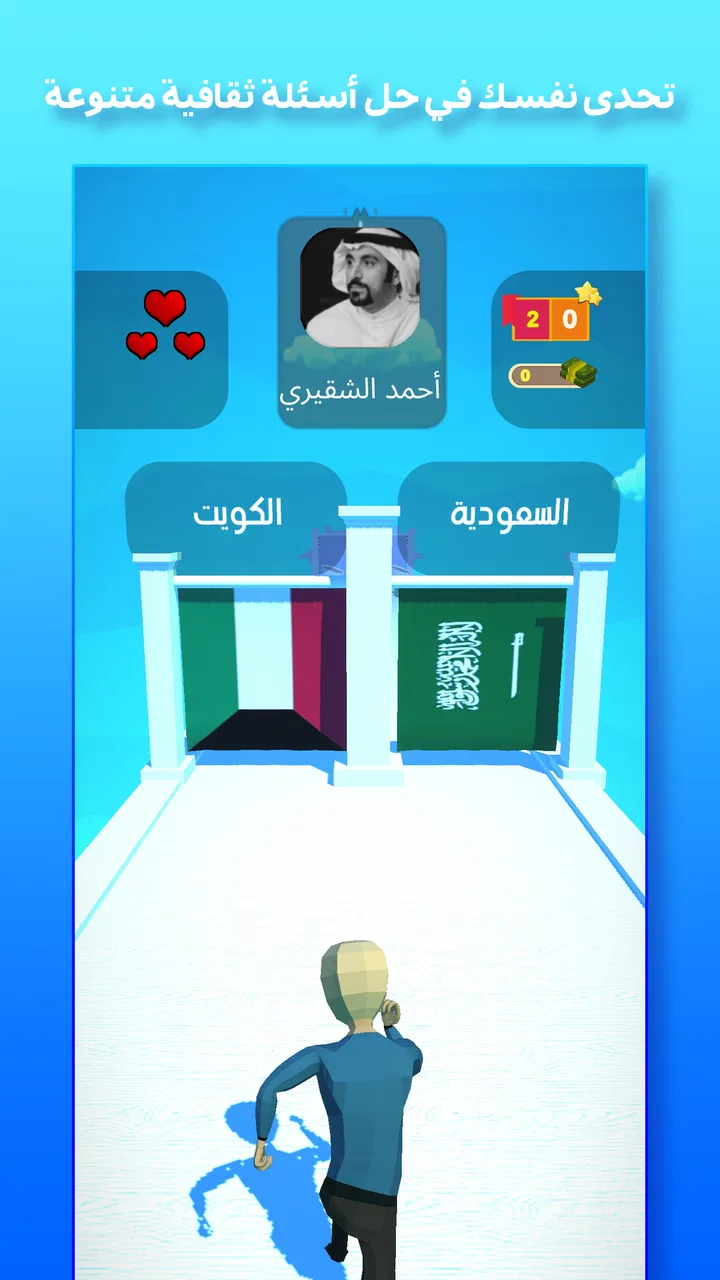
The basic idea is simple. You answer questions, deal with obstacles along the route, and try to reach the goal. That structure gives the game more direction than a loose collection of quiz questions. You are not only checking whether you know an answer; you are also trying to keep moving. That combination makes each mistake feel more noticeable, although it also means the experience depends heavily on whether the question selection matches your interests and knowledge.
How the game turns quick questions into a journey
The first thing I noticed is that the game presents trivia as progress toward something, rather than as an endless list of unrelated prompts. The early goal is easy to understand: answer correctly and overcome the barrier in front of you. I did not need a long tutorial or a complicated explanation before starting. That immediate clarity is useful for casual players, especially anyone who wants a game that can be opened and understood within a minute.
You May Also Like

 Blood Strike: 2.5 Anniversary
Blood Strike’s Loadouts Turn Every Drop Into a Tactical Gamble
A close look at Blood Strike’s custom loadouts: how fast access to signature weapons reshapes its battle royale rhythm, rewards preparation, and narrows the gap between fights.

 Pandora - Music & Podcasts
Pandora’s Music Is Easy to Start, but Harder to Recover
Pandora’s strength is its low-effort path from a seed to a station. Its weak spot is how much confidence it asks you to place in connection, setup, and quiet recovery.

 8 Ball Pool
 Is Built on Rivalries, Rematches, and Routine
A close look at the rivalries, rematches, shared routines, and unanswered safety questions that turn a quick pool match into a persistent mobile community.

 Samsung Music
’s Quiet Strength Is Playing What You Already Own
Its reach comes less from spectacle than from dependable access to a personal library. That simplicity is both the app’s strongest retention engine and its ceiling.

 AccuWeather: Weather Radar
AccuWeather Review: A Quick, Clear Forecast for Everyday Decisions
For everyday plans, the best forecast is the one you can understand quickly. AccuWeather makes rain timing, radar, and local conditions easy to act on, with a few trade-offs.

 Hill Climb Racing
Why Hill Climb Racing Still Turns Crashes Into One More Run
A tiny car, a bumpy hill and one more upgrade: Hill Climb Racing keeps resurfacing because its simple chaos makes every near-miss feel personal.
More From Our News Desk



That goal also changes the feeling of a wrong answer. In a standard quiz app, an incorrect response may simply reduce a score. Here, the idea of a barrier makes the answer feel like part of a journey. Even when the question itself is not especially memorable, the desire to get past the current obstacle gives me a reason to try again. The game works best when the goal remains close enough to feel achievable, rather than distant or abstract.
I would describe the opening experience as approachable rather than dramatic. There is no need to learn a large collection of controls, and the trivia format does most of the teaching. This is a good fit for people who enjoy general knowledge but do not want a demanding game interface. It is also suitable for younger players within the Everyone age rating, provided an adult is comfortable with the cultural content and the way the game handles purchases.
One useful way to play is to treat the first few rounds as a calibration period. Instead of judging the whole game after a single difficult question, I paid attention to the kinds of topics that appeared, how quickly the game moved between questions, and whether the obstacles felt motivating or irritating. That approach matters because a trivia game can feel either pleasantly varied or unfair depending on how familiar its subject matter is to you.
The cultural focus is the main reason to choose this over a generic reflex game. I get more value from a question that makes me remember a fact, reconsider an assumption, or notice a gap in my knowledge than from a purely repetitive tap challenge. At the same time, players looking for tightly specialized quizzes may find the broad approach less satisfying than an app built around one subject such as sport, history, or entertainment.
What progress feels like during ordinary play
The game communicates progress through the act of advancing toward the desired goal. That is a modest but effective signal. I always know what I am trying to do next, which keeps the experience from becoming a passive test. The most satisfying moments come when I solve a question that initially seems uncertain and continue forward without breaking the rhythm.
Progress in a trivia game is naturally personal. A knowledgeable player may move quickly through familiar cultural subjects, while another player may feel that the same sequence is a serious test. I appreciate that this creates room for improvement without requiring a traditional character-building system. My progress is visible in better decisions, quicker recognition, and a growing sense of which questions deserve careful reading.
There is also a useful psychological distinction between knowing an answer and recognizing it under pressure. When I played quickly, I occasionally selected a familiar-looking option before properly reading the question. Slowing down by a few seconds improved my results more than trying to memorize every fact. That is one of the game’s practical lessons: careful reading is often as important as cultural knowledge.
For a more social use case, I can imagine passing the device around during a family gathering and letting each person answer questions in turn. The journey structure gives everyone a shared point of attention, while the short format prevents the activity from taking over the entire evening. It is less suitable for a formal multiplayer competition because the core appeal is personal progress rather than a clearly described head-to-head format.
Another useful routine is to play in short bursts instead of forcing a long session. I found that this protects the questions from becoming repetitive and makes each return feel more purposeful. A quick round during a commute or a break can work well, while someone seeking a deep, hour-long gaming session may notice that the simple question-and-obstacle loop does not offer enough variety by itself.
Difficulty, mistakes, and the pace of the challenge
The difficulty curve is best understood as a test of familiarity and attention rather than physical skill. Some questions can be answered immediately, while others require a pause to compare possible choices. That variation helps the game avoid feeling completely automatic. If every question were obvious, the journey would lose its tension; if every question demanded specialist knowledge, casual players would stop enjoying the progress.
In my experience, the most important pacing factor is the alternation between confidence and doubt. A run feels lively when a straightforward question is followed by one that makes me think. The balance becomes less comfortable when several questions in a row depend on knowledge I do not happen to have. At those moments, the barrier can feel less like a challenge I can overcome and more like a random interruption.
That is a limitation worth considering before installing. Trivia cannot be perfectly fair to every player because cultural knowledge differs by age, education, location, and personal interests. A question that feels basic to one person may be completely unfamiliar to another. I therefore recommend approaching the game as a learning-oriented quiz, not as a definitive measurement of intelligence.
My best practical tip is to read the full wording before looking for a familiar keyword. Questions in this format often reward precision. A hurried answer based on one recognizable word can be less reliable than a slower answer based on the entire sentence. I also found it helpful to separate genuine uncertainty from simple impatience: if I knew two options were plausible, taking an extra moment was worthwhile; if I had no idea, guessing and moving on was healthier than overthinking.
The pace suits players who like frequent decisions with little setup. It does not suit someone who wants detailed explanations after every answer or a structured study course. The value here comes from the flow of questions and the motivation to clear the next barrier. If your priority is learning why an answer is correct, a dedicated educational quiz platform may be a better companion.
What keeps the journey moving, and where it may lose force
The game’s retention strength comes from small, immediate goals. Reaching the next point is easier to understand than chasing a distant high score, and each successful answer provides a reason to continue. I found myself thinking, “I will just clear this next obstacle,” which is exactly the kind of modest commitment that can turn a two-minute break into a longer session.
That same design can create retention pressure. When progress is framed as a route toward a goal, stopping near an obstacle may feel unfinished. This can be motivating when I am in the mood for another attempt, but it can also become tiring if the questions stop feeling fresh. The game is strongest when the desire to continue comes from curiosity, not from frustration or the feeling that I must keep playing to recover lost progress.
The free entry point makes it easy to try without committing money. The game includes optional in-app purchases priced from around $1.49 to $7.99 per item, so I would advise checking the purchase flow before handing the device to a child. The presence of optional spending does not prevent casual enjoyment, but it is a relevant consideration for families and for anyone who prefers a completely uninterrupted free experience.
I also paid attention to the relationship between challenge and patience. A good trivia game should make me want to improve, not simply make me repeat the same attempt until luck changes. If a player enjoys learning from mistakes, the obstacles can provide a useful reason to return. If a player dislikes failure in knowledge-based games, the same structure may feel more pressuring than rewarding.
Compared with a conventional quiz app that focuses only on scores, this game has a clearer sense of direction. Compared with a large social trivia platform, it feels more personal and less dependent on a busy competitive environment. The trade-off is that players who want live opponents, extensive statistics, or a huge range of modes should look elsewhere. This is a focused journey built around answering questions, not an all-purpose trivia hub.
Who will get the most from it
I would recommend it to Arabic-speaking players who enjoy broad cultural trivia and want a lightweight game with an obvious next objective. It is particularly suitable for short sessions, family-friendly play, and people who like the feeling of gradually getting past obstacles. The Everyone rating also makes it approachable for a wide audience, although the actual enjoyment will still depend on the player’s familiarity with the subjects used.
It can also work for someone trying to make idle moments more mentally active. Instead of opening a purely passive feed, I can spend a few minutes recalling facts, comparing answers, and noticing where my knowledge is uneven. That does not turn the game into a formal learning tool, but it gives the break a little more substance than a simple time-filler.
I would skip it if you want a deep strategy game, a story-driven adventure, or a highly competitive online quiz with detailed rankings. I would also be cautious if you dislike broad cultural questions that may sometimes feel outside your personal experience. Players who need explanations, custom categories, or a carefully controlled difficulty setting may find a more specialized alternative more rewarding.
Device compatibility is straightforward for many users because the game requires Android 8.0 or later. On Android, the current version is 844, and the title has passed one million installs, which suggests that it has reached a substantial casual audience. Its average rating is 3.7 from around 4.4 thousand ratings, so I would treat it as a promising but not universally loved experience rather than assuming it will suit everyone.
My verdict on goals, unlocks, and long-term pacing
What works best is the connection between a correct answer and visible forward movement. The game gives each question a purpose, and that purpose makes ordinary trivia feel more active. I also like that the basic loop can be understood immediately, making it easy to recommend for a quick shared session or a few quiet minutes alone.
What limits the experience is the narrowness of that loop. The motivation to continue depends on the quality and variety of the questions, as well as on whether the obstacles feel fair for the individual player. Without a strong personal interest in cultural trivia, the journey may lose momentum. The optional purchases are another point to keep in mind, especially in a family setting where accidental spending is a concern.
My final judgement is positive but specific: this is a good choice for a free, accessible Arabic trivia game with goal-based progression, not a replacement for a feature-heavy quiz platform or a serious educational course. I enjoyed it most when I played in short sessions, read carefully, and treated missed answers as clues about what I need to learn rather than as a reason to become frustrated.
GX studios has kept the central idea easy to grasp, and that simplicity is both the game’s strength and its boundary. If you want cultural questions wrapped in a small journey, حلها عالماشي - اختبر ثقافتك is worth trying. If you need rich explanations, specialized subjects, or a more elaborate progression system, choose a different trivia alternative. For casual players who value quick goals and a gentle mental challenge, it earns a place on the shortlist.
FAQs for حلها عالماشي - اختبر ثقافتك
01What is حلها عالماشي - اختبر ثقافتك?
حلها عالماشي - اختبر ثقافتك is an Arabic trivia and general-knowledge game designed for players who enjoy testing their culture, memory, and quick-thinking skills. It presents questions across different topics, allowing you to challenge yourself, discover new information, and compete for better results. The game is suitable for casual sessions when you want entertainment with an educational element.
02What types of questions are included in the game?
The game focuses on general culture and may include questions related to history, geography, science, sports, literature, religion, entertainment, and everyday knowledge. The variety helps keep each round interesting and prevents the experience from feeling repetitive. Question difficulty can vary, so some rounds may be accessible to beginners while others require broader knowledge or careful thinking.
03Is حلها عالماشي - اختبر ثقافتك suitable for children?
The game can be enjoyable for teenagers, adults, and families who understand Arabic and like quiz challenges. However, parents should review the questions and the app’s content before allowing younger children to play, because age suitability may differ depending on the topics presented. It is also worth checking the store listing for the current age rating and any content guidance.
04Does the app require an internet connection to play?
Whether an internet connection is needed can depend on the version of the application and the features being used. Basic quiz content may work offline if it has already been included in the app, while advertisements, updates, leaderboards, online competitions, or newly downloaded questions may require connectivity. Check the app permissions and store description before downloading if offline play is important to you.
05Is حلها عالماشي - اختبر ثقافتك free to download, and does it contain advertisements?
The application may be available as a free download, but free quiz games commonly support development through advertisements or optional purchases. The exact arrangement can change between Android and iOS versions, regions, and future updates. Before installing, review the official store page for pricing, in-app purchase information, advertising details, and requested permissions so you know what to expect.
Pros
- Quick trivia rounds are ideal for short breaks or casual play.
- Covers varied topics
- helping keep each session fresh and unpredictable.
- Arabic interface makes the game accessible to native Arabic speakers.
- Simple controls let new players start answering questions immediately.
- A good option for solo players who enjoy testing general knowledge.
Cons
- Question difficulty may vary noticeably from one round to another.
- Some questions may depend on regional or culturally specific knowledge.
- Repeated play can feel less engaging if the question pool is limited.
- Players seeking detailed explanations may find answers lack educational context.
- Arabic-only content may not suit users who prefer another language.

حلها عالماشي - اختبر ثقافتك
Gallery